
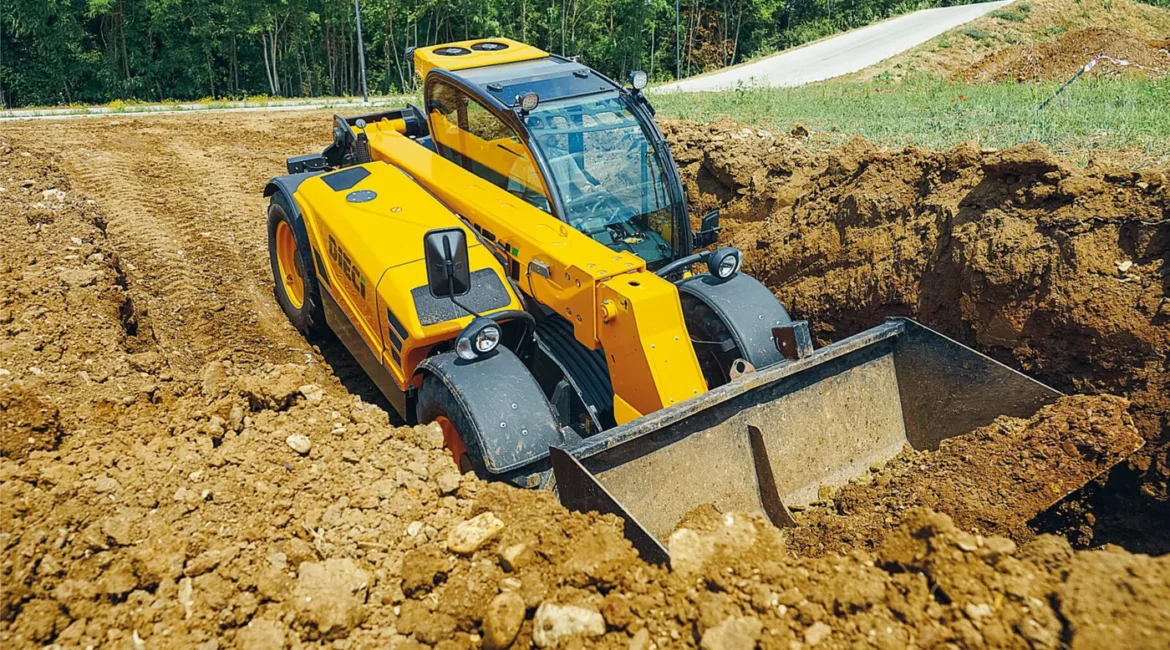
Fixed and rotating telehandlers both combine a telescopic boom with interchangeable attachments, but their working patterns differ. Choosing the right type starts with the load, lift height, forward reach, pick-and-place locations, site layout and the way the machine will move between tasks.
This guide outlines the main selection factors. Capacity at a particular boom position must always be checked against the load chart for the exact machine, attachment and configuration.
What is a fixed telehandler?
A fixed telehandler has a boom mounted to a chassis without continuous upper-structure rotation. The machine is repositioned to align with the pick-up and placement points. This straightforward layout is widely used in agriculture, construction, materials handling and industrial applications.
Fixed telehandlers are available in varied sizes and capacities, from compact machines for constrained areas to heavy-duty models for substantial loads. They can be a practical choice when the machine has clear travel paths and the work sequence allows regular repositioning.
What is a rotating telehandler?
A rotating telehandler has an upper structure that rotates relative to the chassis. From a suitable stabilised position, the boom can serve work areas around the machine without the chassis moving for every lift.
This can be useful on sites where access is restricted, multiple placement points surround one setup area, or repeated repositioning would be inefficient. Review the rotating telehandler range for available lift heights and configurations.
Map the complete lifting task
Record the maximum load weight, load dimensions, centre of gravity, pick-up point, placement height and horizontal distance. Repeat the exercise for normal lifts, not only the single heaviest load. A machine may have a high headline capacity close to the chassis but a lower allowable capacity at extended reach.
Use the manufacturer’s load chart for the exact attachment and machine setup. Forks, buckets, jibs, platforms and other attachments change the lifting configuration and may change allowable capacity.
Site layout and repositioning
A fixed telehandler may be efficient on open sites with clear routes between storage, loading and placement areas. Consider turning space, travel surface, gradients, overhead restrictions and interaction with people or other equipment.
A rotating telehandler can reduce chassis movements when several work faces can be served from one suitable position. That benefit depends on correct setup, stabilisation, exclusion zones and available space for the rotating structure and boom.
Stabilisers and ground conditions
Review whether the intended lifts require stabilisers and how much setup space is available. Ground bearing capacity, level, underground services, edges and changing site conditions all need consideration. A larger working envelope does not remove the need for a suitable support surface.
Attachments and versatility
Telehandler versatility comes from compatible attachments, but each attachment must be approved for the machine and reflected in the operating information. Define the main attachment rather than assuming one machine will perform every task equally well.
For agricultural use, buckets, grabs and bale-handling attachments may be central to the decision. Construction and industrial applications may prioritise forks, jibs or access-platform compatibility. Confirm hydraulic, coupling and capacity requirements before ordering.
Transport, storage and ownership support
Compare overall dimensions, mass, transport arrangements, storage height and access to service areas. Review parts availability, planned servicing, inspections, training and attachment support. A machine that fits the lift on paper must also fit the business’s transport and maintenance arrangements.
Telehandler selection checklist
- Load weight, dimensions and centre of gravity.
- Maximum lift height and horizontal reach.
- Load-chart capacity at the required boom position.
- Approved attachment and coupling requirements.
- Travel routes, turning space and overhead restrictions.
- Setup area, stabiliser space and ground condition.
- Frequency of chassis repositioning between lifts.
- Transport dimensions, service support and operator requirements.
Explore Wing Gear’s complete telehandler range, compare fixed models with rotating models, or contact the team with your load, height and reach requirements.