When a job requires access at height, choosing a boom lift is only the first decision. The next question is often whether you need an articulating boom lift or a telescopic boom lift.
Both machines are elevated work platforms designed to position workers, tools and equipment at height, but they reach the work area in very different ways.
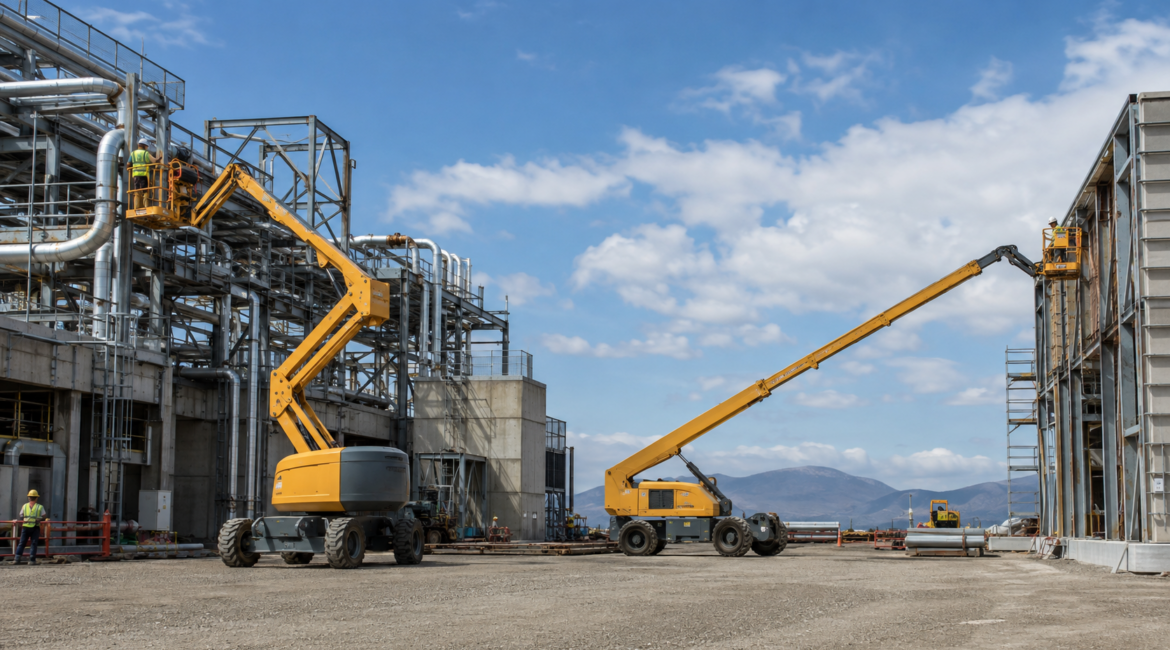
An articulating boom lift uses a jointed or folding boom that can move up, over and around obstacles. A telescopic boom lift, often called a straight boom, extends outward in a more direct line and is generally better suited to applications requiring substantial height and horizontal outreach.
The better choice depends less on which machine looks more capable and more on the actual worksite.
Is there a clear path to the work area? Are structures or machinery in the way? How much horizontal reach is required? How much room is available for the machine to manoeuvre?
Those questions usually tell you more than maximum working height alone.
What Is an Articulating Boom Lift?
An articulating boom lift has multiple boom sections connected by pivot points or joints.
These joints allow the boom to bend as it rises, giving the platform the ability to travel up, over and around obstacles rather than following a single straight path. Because of this jointed design, articulating boom lifts are also commonly referred to as knuckle booms.
Imagine maintenance needs to be carried out behind pipework, above warehouse shelving or on the far side of part of a building.
The machine may not be able to position itself directly underneath the work area.
An articulating boom can provide another approach. The first section raises the platform, while the additional joints help position it around whatever sits between the machine and the destination.
That ability makes articulating boom lifts particularly useful where access is complicated by buildings, plant, structural steel, services or other obstacles.
Wing Gear’s current articulating boom range includes electric and engine-powered machines intended for applications including construction, warehousing, aviation, utilities, maintenance and industrial facilities.
What Is a Telescopic Boom Lift?
A telescopic boom lift uses one or more boom sections that extend outward in a relatively straight line.
This is why telescopic boom lifts are also known as straight booms.
Instead of bending around an obstacle, the machine is designed to create a direct route towards the work area. The telescoping sections slide outward to increase both height and horizontal reach.
That makes a telescopic boom particularly useful where the machine cannot get close to the work but still has a clear line towards it.
Examples could include work on a high building façade, structural steel, an industrial facility or an area that needs to be accessed from the opposite side of unsuitable ground.
Wing Gear’s telescopic boom lifts include electric and diesel models designed for direct horizontal and vertical reach across construction, utilities, building maintenance, shipbuilding, airports, ports and industrial applications.
Articulating Boom Lift vs Telescopic Boom Lift: The Main Difference
The easiest way to understand the difference is to think about the path the platform needs to take.
An articulating boom can change direction as it rises.
A telescopic boom mainly extends towards the destination.
That one difference influences nearly every other part of the comparison.
| Factor | Articulating Boom Lift | Telescopic Boom Lift |
| Boom design | Jointed/folding boom | Straight telescoping boom |
| Also called | Knuckle boom | Straight boom |
| Main strength | Reaching over and around obstacles | Direct height and horizontal outreach |
| Obstacle clearance | Excellent | Limited without repositioning |
| Horizontal outreach | Generally lower than comparable straight booms | Generally greater |
| Tight-site manoeuvrability | Often better | Usually needs more operating space |
| Open-site work | Suitable | Particularly well suited |
| Positioning | Multiple approach angles | More direct approach |
| Typical use | Maintenance, congested sites, work around structures | Construction, steelwork, façade work, open industrial sites |
The exact capability always depends on the individual model, so working height, outreach, platform capacity and operating dimensions should still be checked against the manufacturer’s specifications.
1. Horizontal Reach
Horizontal reach is one of the biggest differences when comparing an articulating boom lift vs telescopic boom lift.
A telescopic boom has fewer changes of direction between the machine and the platform. Its straight sections extend directly outward, allowing much of the boom length to contribute to horizontal outreach.
Manufacturers therefore generally position straight booms as the stronger option where long-distance horizontal access is the priority.
Consider a job where a machine must remain well away from the side of a structure because of landscaping, excavation or another ground-level restriction.
If there is a clear line between the machine and the work area, the additional horizontal outreach of a telescopic boom may be more useful than articulation.
An articulating boom may not reach as far horizontally, but raw distance is not always what the job requires.
Sometimes the challenge is reaching the right place from the right angle.
2. Reaching Over and Around Obstacles
This is where an articulating boom normally has the advantage.
Because the boom contains multiple pivot points, the platform can follow a more complex path towards the work area.
JLG, for example, identifies up-and-over access and difficult positioning around obstacles as the main advantages of an articulating design.
Think about working:
- Behind structural steel
- Above warehouse shelving
- Around fixed machinery
- Across a wall
- Around roof structures
- Near HVAC or electrical installations
In these situations, being able to change the boom angle at several points may be more valuable than having maximum straight-line reach.
This is why the question should not simply be:
“How far can the boom reach?”
A better question is:
“What path does the platform need to take to reach the work?”
3. Working Height
Telescopic boom lifts are commonly selected for demanding applications where substantial working height and outreach are required.
Their straight-boom design is particularly effective when there is a relatively unobstructed route between the machine and the elevated work area. JLG notes that telescopic models can often reach higher than comparable articulating machines, although the actual result depends on the specific machines being compared.
That distinction is important.
Do not assume that every straight boom reaches higher than every articulating boom.
Boom-lift ranges overlap considerably.
For example, Wing Gear’s current articulating range includes machines with significant working heights, while its telescopic range includes straight booms extending into larger working envelopes. Machine selection should therefore be based on the actual model specifications rather than boom type alone.
4. Manoeuvrability and Site Space
A machine’s reach is only useful if you can position it where it needs to work.
Articulating boom lifts often have an advantage on sites where space is restricted.
Their ability to reach around obstacles can reduce the need to place the chassis directly in line with the target, while some designs have relatively compact operating profiles.
JLG notes that articulating boom lifts are particularly useful in space-restricted sites, while telescopic boom lifts generally benefit from having more room around the chassis for positioning and movement.
This makes articulating booms worth considering for:
- Warehouses
- Industrial maintenance
- Indoor facilities
- Congested construction sites
- Areas with fixed machinery
- Sites with restricted machine positioning
Telescopic booms are often more at home on larger sites where there is enough space to manoeuvre the chassis and create a direct approach to the work.
Before selecting either type, check the machine’s overall width, stowed length, turning requirements and tail swing—not just its maximum working height.
5. Platform Positioning
There is also a difference between getting close to the work and getting the platform into exactly the right position.
Articulating booms provide several points of movement through their jointed boom sections.
This can help the operator make positioning changes without having to move the complete machine every time the work area changes.
That flexibility can become valuable during maintenance work where several components need attention around the same structure.
A telescopic boom takes a more direct approach.
If the work area is clear and the operator mainly needs to reach one distant position, that simplicity can be an advantage.
The practical rule is straightforward:
Complicated route to the work area → consider articulation.
Long, clear route to the work area → consider telescopic reach.
6. Indoor vs Outdoor Work
Neither boom type is exclusively an indoor or outdoor machine.
The power source, tyres, dimensions, gradeability and site requirements matter just as much as the boom geometry.
Wing Gear’s articulating boom range includes fully battery-powered models designed for low-noise, zero-emission-at-point-of-use applications, including indoor work, alongside engine-powered options.
The telescopic range also includes both electric and diesel models.
For an indoor industrial facility, an electric articulating boom may make sense because the site combines emissions requirements with obstacles and limited manoeuvring space.
For an outdoor construction project where the platform needs to travel a long distance towards a building façade, a telescopic model may offer the more useful working envelope.
But those are application examples—not universal rules.
Always match the machine, not simply the boom category, to the work environment.
7. Rough Terrain and Ground Conditions
Ground conditions should be assessed before comparing height or outreach.
Consider:
- Surface strength
- Slopes and gradients
- Uneven terrain
- Soft ground
- Obstacles
- Access routes
- Space for turning
- Travel distance between work areas
A machine designed for prepared indoor floors will have very different requirements from one intended for a large outdoor construction site.
Wing Gear’s current boom-lift ranges include models with different gradeability and operating characteristics, reinforcing why individual machine specifications need to be checked against the site rather than assuming all articulating or telescopic booms behave the same way.
If the ground is unsuitable for safely positioning the EWP, having additional boom reach does not solve the underlying problem.
8. Platform Capacity
Working height gets most of the attention, but platform capacity can be just as important.
The platform may need to carry:
- One or more workers
- Tools
- Equipment
- Installation components
- Other permitted materials
Wing Gear’s current range demonstrates that platform capacity varies considerably by model within both articulating and telescopic categories.
That means you should not choose an EWP on the assumption that a larger machine automatically provides the capacity required throughout its complete working envelope.
Check the rated platform capacity and any restrictions specified for the actual model.
Articulating Boom Lift vs Telescopic Boom Lift for Construction
Both types of boom lifts are widely suited to construction, but they often solve different access problems.
A telescopic boom lift can make sense when workers need to reach:
- Building façades
- Structural steel
- Roofing areas
- Large open structures
- Elevated work points with a clear approach
- Work areas located a substantial distance from the machine
An articulating boom lift may be more useful when workers need to reach:
- Behind structural members
- Over walls
- Around building services
- Between existing structures
- Around plant or equipment
- Areas where the chassis cannot sit directly in front of the work
Rather than asking which boom is best for construction in general, map the machine position and work point on the actual site.
That usually reveals which boom design is more practical.
Which Boom Lift Is Better for Maintenance Work?
Maintenance is one area where articulating boom lifts can offer a particularly useful advantage.
Factories, warehouses, airports and commercial facilities often contain obstacles that cannot simply be moved out of the way.
Pipes, machinery, shelving, ducts, structural beams and production equipment may sit between the floor and the maintenance point.
A jointed boom gives the operator more options for approaching that work.
Wing Gear lists plant and venue maintenance, warehousing, aviation, airports, utilities and industrial facilities among common applications for its articulating boom-lift range.
However, where maintenance involves a high or distant point with a clear approach, a telescopic boom may still be the better tool.
Again, the site layout decides.
Articulating vs Telescopic Boom Lift: Which Is Faster to Position?
This depends heavily on the task.
A telescopic boom can provide a relatively direct movement from the chassis towards an unobstructed work area. JLG identifies quicker positioning into high or distant work areas as one of the strengths of straight-boom machines.
An articulating boom requires additional boom movements, but those extra joints may eliminate the need to reposition the chassis when obstacles are present.
So a straight boom may be faster when the route is clear.
An articulating boom may be more efficient when the alternative is repeatedly driving and repositioning the entire machine.
The useful measure is therefore not simply boom speed.
It is how efficiently the complete machine can move through the day’s work pattern.
Electric vs Diesel Boom Lifts
Boom geometry and power source should be considered separately.
You can have electric articulating booms and electric telescopic booms, as well as engine-powered versions of both.
Electric models may suit applications where noise and exhaust emissions at the point of use are important considerations, while diesel machines are commonly selected for demanding outdoor work.
Wing Gear currently offers electric and engine-powered options within its articulating range and electric and diesel options within its telescopic range.
When comparing power sources, consider:
- Indoor or outdoor operation
- Charging availability
- Daily operating hours
- Terrain
- Travel distances
- Noise requirements
- Site emissions requirements
- Gradeability
- Maintenance arrangements
Do not automatically choose diesel because the machine will work outside, or electric simply because the site is indoors. Look at the complete operating cycle.
Do You Need a Licence to Operate a Boom Lift in WA?
Licensing depends on the type and size of elevating work platform being operated.
WorkSafe WA states that workers need the appropriate High Risk Work licence to operate a boom-type EWP where the boom length is 11 metres or more. Operators of other EWPs still need appropriate training, information and instruction to use the equipment safely.
Construction work involving an EWP may also fall within high-risk construction work requirements, meaning a safe work method statement may be required depending on the work being undertaken.
Licensing and competency should therefore be checked before the machine is selected and sent to site rather than treated as an issue to resolve afterwards.
How to Choose Between an Articulating and Telescopic Boom Lift
Start with the work area.
1. Identify the Work Point
Record how high the platform needs to reach and where the machine can realistically be positioned.
2. Look for Obstacles
Are there walls, machinery, steelwork, shelving, services or other structures between the machine and the work?
If yes, articulation may be especially valuable.
3. Measure Horizontal Distance
Determine the horizontal distance between the available machine position and the work point.
If the distance is substantial and there is a clear approach, a telescopic boom may offer the more suitable outreach.
4. Check Available Operating Space
Measure gateways, access roads, building entrances, turning areas and working space around the chassis.
A machine with enough height may still be unsuitable if it cannot be positioned properly.
5. Assess the Ground
Confirm the surface and terrain are appropriate for the machine under the conditions in which it will operate.
6. Calculate Platform Requirements
Consider the number of people, tools and equipment that need to be carried.
Then check the rated capacity of the specific model.
7. Select the Power Source
Consider whether electric or engine-powered equipment better suits the site and daily operating cycle.
8. Check Operator Requirements
Confirm that operators have the required competency, training and licences for the machine and work involved.
9. Compare the Actual Working Envelope
Finally, use the manufacturer’s working-envelope information rather than maximum height alone.
The machine must be capable of placing the platform at the actual height and horizontal position required by the job.
Quick Comparison: Which Boom Lift Should You Choose?
Consider an articulating boom lift when:
- Obstacles sit between the machine and work area
- You need up-and-over access
- The site is congested
- Precise repositioning around structures is important
- The machine cannot always sit directly in front of the work
Consider a telescopic boom lift when:
- Maximum horizontal outreach is important
- There is a clear route towards the work area
- The machine can operate in a relatively open area
- High or distant access is the main requirement
- Straight-line positioning suits the task
These are useful starting points rather than fixed rules. Individual machine specifications and site conditions should always determine the final selection.
What If You Need Vertical Access Rather Than Outreach?
Sometimes neither boom type is the most efficient answer.
If the work area sits almost directly above the machine and there is no need for substantial horizontal outreach, a scissor lift or another type of elevated work platform may better suit the task.
Wing Gear’s guide to scissor lifts vs boom lifts explains how vertical-access requirements differ from the working envelope provided by boom lifts.
You can also compare the complete range of elevated work platforms, including scissor lifts, telescopic boom lifts, articulating boom lifts and vertical mast lifts.
Articulating Boom Lift vs Telescopic: Final Decision
There is no universal winner in the articulating boom lift vs telescopic boom lift comparison.
A telescopic boom is designed around direct reach. When the work area is high or far away and there is a clear path towards it, a straight boom can provide an efficient solution.
An articulating boom solves a different problem. Its jointed sections allow the platform to move up and around obstacles, which can make it far more practical on congested or complicated worksites.
So before comparing models, answer four questions:
Where can the machine stand?
Where does the platform need to go?
What is between those two points?
How much space is available to manoeuvre?
Once those are clear, choosing the right boom type becomes much easier.
Explore Wing Gear’s articulating boom lifts and telescopic boom lifts, or browse the complete elevated work platform range.
If you know your required working height, horizontal reach, platform load and site conditions, contact Wing Gear to discuss suitable equipment.
Frequently Asked Questions
What is the difference between an articulating and telescopic boom lift?
An articulating boom lift has several jointed boom sections that allow it to reach up and around obstacles. A telescopic boom lift uses straight extending sections to provide more direct horizontal and vertical reach.
Is an articulating boom lift the same as a knuckle boom?
Yes. Articulating boom lifts are commonly referred to as knuckle booms because of the joints or knuckles that allow the boom sections to bend.
Is a telescopic boom lift the same as a straight boom?
Yes. A telescopic boom lift is commonly called a straight boom because its telescoping sections extend in a direct line rather than using multiple articulating joints.
Which boom lift has more horizontal reach?
Telescopic boom lifts generally provide greater horizontal outreach than comparable articulating boom lifts because their straight sections extend directly towards the work area. Exact outreach depends on the individual machine.
Which boom lift is better for tight spaces?
An articulating boom is often better suited to restricted or obstacle-heavy sites because its jointed boom provides more options for approaching the work area. Machine dimensions and turning requirements still need to be checked for the specific site.
Which boom lift is best for construction?
It depends on the access pattern. Telescopic booms are particularly useful for high or distant work with a clear approach, while articulating booms are useful where structural elements and other obstacles make direct access difficult.
Can articulating and telescopic boom lifts be electric?
Yes. Wing Gear currently lists electric options in both its articulating and telescopic boom-lift ranges, alongside engine-powered alternatives.
Do I need a licence for a boom lift in Western Australia?
WorkSafe WA states that a High Risk Work licence is required to operate a boom-type EWP where the boom length is 11 metres or more. Appropriate training and competency are still required for other EWP operation.