
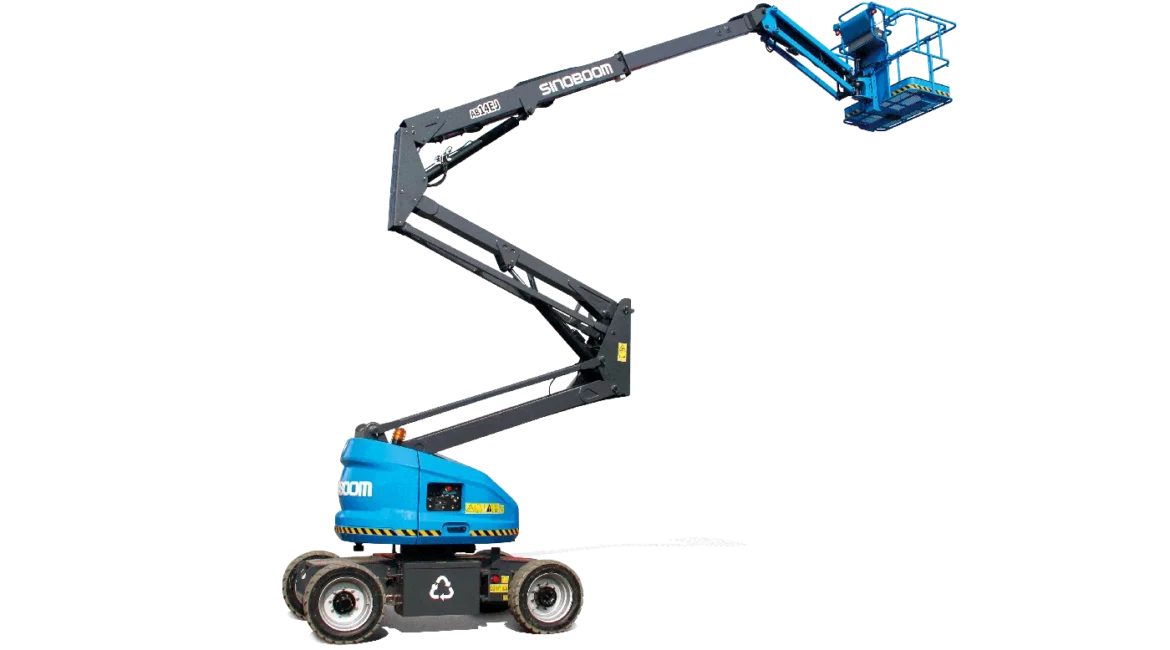
Scissor lifts and boom lifts both provide elevated access, but they solve different problems. The right elevated work platform depends on where the work is located, whether obstacles must be crossed, the required platform capacity, ground conditions and how the machine will move around the site.
This guide explains the main differences between scissor lifts, telescopic boom lifts and articulating boom lifts. Final equipment selection and operation must follow the manufacturer’s instructions, site risk assessment and applicable workplace requirements.
How a scissor lift moves
A scissor lift raises its platform largely in a vertical line. The expanding scissor mechanism supports a comparatively spacious platform that can suit tasks involving more than one worker, tools or materials, subject to the rated capacity.
Scissor lifts are often considered for installation, inspection, warehousing, maintenance and construction work where the machine can be positioned beneath or close to the work area. Indoor electric models can be compact and manoeuvrable, while rough-terrain models are designed for more demanding outdoor conditions.
How a boom lift moves
A boom lift places a smaller work platform at the end of an extendable structure. It can provide vertical and horizontal reach, allowing the platform to approach work that is not directly above the machine.
Telescopic boom lifts extend in a relatively direct line and are useful where long outreach and an open approach are required. Articulating boom lifts use jointed boom sections that can help the platform move up and over obstacles.
Compare reach, not only platform height
Working height is important, but it is not the only reach measurement. Record the horizontal distance from a practical machine position to the work face, the height and width of obstacles, and the clearance available for the chassis and boom.
A scissor lift may be efficient when the platform can sit directly beneath the task. A boom lift may be necessary when shelving, structures, plant, landscaping or other obstacles prevent close positioning.
Platform size and capacity
Scissor lifts commonly offer larger platforms than boom lifts, which can be useful for multiple workers and materials. Confirm the rated platform capacity and include people, tools and materials in the total.
Boom platforms are generally smaller and prioritise reach. The intended task should be planned so that workers are not encouraged to overload the platform or reach beyond the guardrails.
Indoor, outdoor and rough-terrain use
For indoor work, review overall machine width, turning space, floor loading, tyre type, emissions, noise and doorway access. Compact electric scissor lifts and vertical mast lifts can be useful where space is limited.
Outdoor work requires closer attention to terrain, gradients, stabilisation, weather, wind limits and access routes. A machine described as rough terrain still has operating limits; the ground and route must suit the specific model and manufacturer requirements.
Electric or engine-powered equipment
Electric EWPs can support lower-noise, zero-tailpipe-emission operation at the machine and may suit indoor or environmentally sensitive work. Charging access and duty cycle need to be planned.
Engine-powered and hybrid machines may suit longer outdoor shifts or locations where charging is difficult. Compare the complete work pattern, not only the power source.
When a vertical mast lift may fit
A vertical mast lift can suit low-level access and constrained spaces where a larger scissor or boom is unnecessary. Review platform capacity, outreach, machine width and the exact work position before choosing.
EWP selection checklist
- Required working height and horizontal outreach.
- Obstacles between the machine and work area.
- Number of people, tools and materials on the platform.
- Indoor or outdoor environment and available ventilation.
- Ground condition, gradients, floor loading and travel route.
- Doorways, turning space and restricted access points.
- Power source, shift length and charging or fuel access.
- Site rules, operator competency and rescue planning.
Compare Wing Gear’s full elevated work platform range, including scissor lifts, telescopic booms, articulating booms and vertical mast lifts. For help matching reach and access requirements to a machine, contact Wing Gear.