
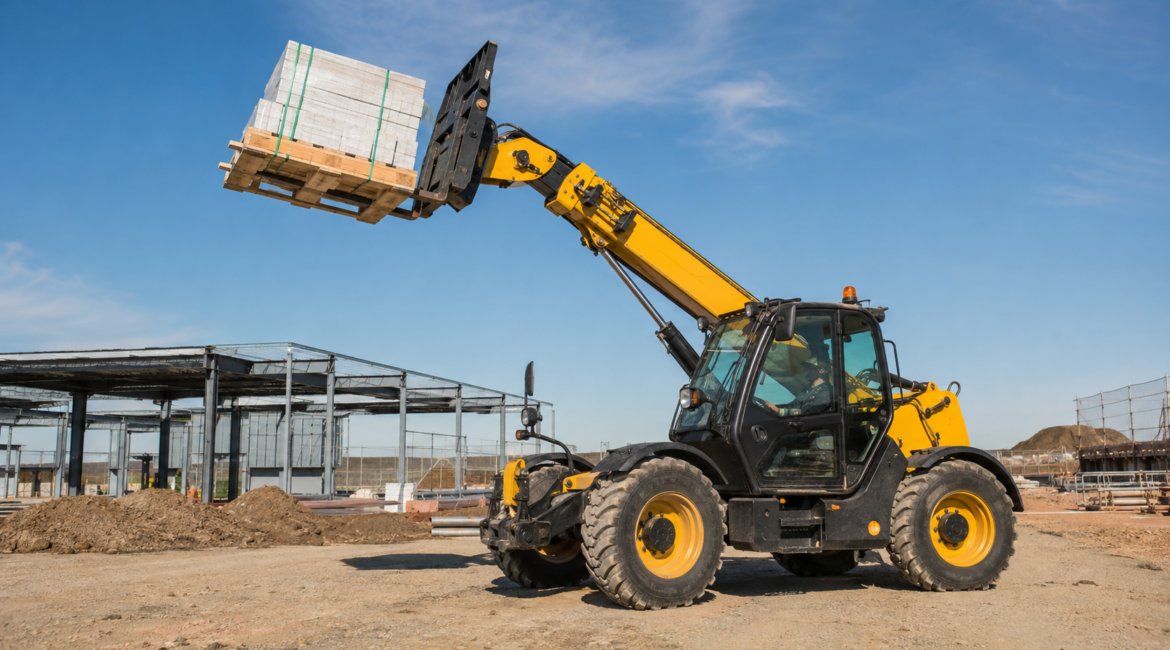
If you have spent time around a construction site, farm, mine or industrial yard, you have probably seen a machine that looks a little like a forklift but has a long boom extending from the chassis. That machine is most likely a telehandler.
A telehandler, short for telescopic handler, is a mobile material-handling machine built around a telescopic boom that can extend upwards and forwards. Instead of only lifting a load vertically, as a conventional forklift generally does, a telehandler can reach across obstacles and place materials at different heights and distances from the machine.
That extra reach is what makes the telehandler such a useful piece of equipment. With the correct attachment and machine configuration, it can handle palletised materials, bulk products, suspended loads and other specialised lifting tasks across construction, agriculture, mining and industrial environments.
Businesses comparing machines for these applications can explore Wing Gear’s full range of telehandlers, including both fixed and rotating configurations.
How Does a Telehandler Work?
The easiest way to understand a telehandler is to look at its telescopic boom.
The boom is made from sections that extend and retract, allowing the operator to change both the height and forward reach of the attachment. Hydraulic systems control the boom movements, while the machine’s chassis, tyres, steering and drivetrain allow it to travel around the worksite.
At the end of the boom is an attachment point. Depending on the machine and the task, this could hold pallet forks, a bucket, grab, lifting jib or another manufacturer-approved attachment.
This combination of mobility, lift height, forward reach and interchangeable attachments is what separates a telescopic handler from many other material-handling machines.
It is important, however, to understand that a telehandler’s maximum capacity is not available at every boom position. As the boom extends forwards or upwards, the allowable load can change considerably.
Operators therefore need to work from the load chart for the exact machine, attachment and configuration rather than relying only on the headline maximum lifting capacity.
What Are the Main Parts of a Telehandler?
While the exact design varies between models, most telehandlers share several fundamental components.
The chassis provides the structural base of the machine and supports the cab, engine, drivetrain and lifting system.
The telescopic boom is the defining feature. It extends and retracts to provide the machine’s vertical and horizontal reach.
The operator cab contains the steering and boom controls and is positioned to provide visibility of the machine, attachment and surrounding work area.
At the end of the boom, the attachment interface allows suitable tools to be fitted for different applications.
Depending on the telehandler, there may also be stabilisers or outriggers used for particular lifting configurations.
Rotating telehandlers add a rotating upper structure that allows the boom and cab assembly to work around the machine from an appropriately prepared position.
What Is the Difference Between a Telehandler and a Forklift?
Telehandlers and forklifts can both move and lift materials, and both may be fitted with fork tines. Their designs and working capabilities, however, are quite different.
A conventional forklift uses a mast and elevating load carriage. Its primary movement is vertical, making it particularly effective for repetitive pallet handling in warehouses, yards and other relatively controlled environments.
A telehandler uses a telescopic boom. The boom can raise a load while also extending it forwards, giving the operator considerably more flexibility when the destination cannot be approached directly.
| Feature | Telehandler | Conventional Forklift |
| Lifting system | Telescopic boom | Vertical mast |
| Forward reach | Yes | Limited |
| Attachment options | Multiple options, model dependent | Primarily material-handling attachments |
| Typical environment | Construction, agriculture, mining and industrial sites | Warehouses, yards and hardstand areas |
| Load placement | Height and forward reach | Primarily vertical lift |
| Machine selection | Load, height, reach, attachment and site conditions | Load, lift height and operating space |
This does not mean a telehandler is automatically a better choice.
If a business is repeatedly moving pallets across a smooth warehouse floor, a conventional forklift may be the more practical machine. Where loads need to be placed over an obstacle, onto an elevated structure or across variable site conditions, the telehandler’s boom provides capabilities a standard forklift does not.
The right equipment should always be selected around the application rather than assuming one machine can perform every material-handling task.
What Is a Telehandler Used For?
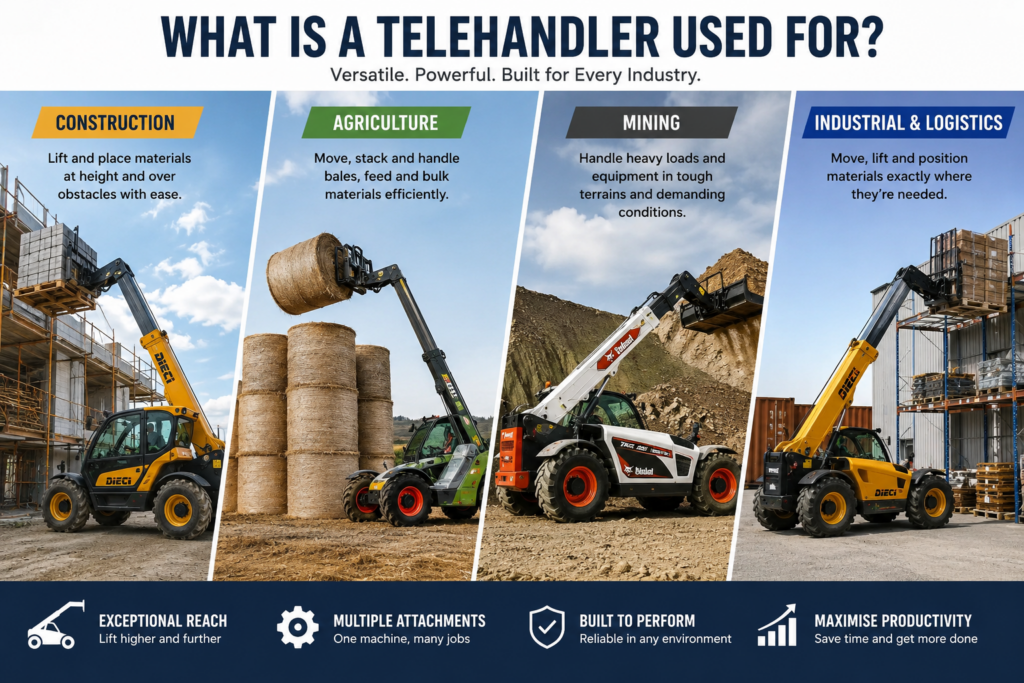
One reason telehandlers are found across so many industries is that their role can change with the application.
Construction
On construction sites, telehandlers are commonly used to move building materials and place loads at locations that would be difficult for a conventional forklift to access.
For example, a pallet may need to be lifted from ground level and placed onto an elevated work area. Instead of moving directly underneath the placement point, a telehandler can provide forward reach while lifting the load.
The same capability can be useful when working around walls, trenches, temporary structures or other site obstacles.
Agriculture
Agricultural operations can require a very different type of material handling.
Telehandlers may be configured for moving and stacking bales, handling feed or other bulk materials, loading equipment and carrying out general farm material-handling tasks.
The advantage is not simply how much the machine can lift. It is the ability to combine reach, mobility and different approved attachments in one machine.
For operations where the machine regularly moves between different loading and handling tasks, this versatility can be particularly valuable.
Mining
Mining environments may require machinery capable of working around demanding terrain, substantial loads and site-specific operating requirements.
A telehandler may be used for moving equipment, palletised materials, maintenance supplies or other loads around a site.
Machine selection in mining environments should consider much more than lifting capacity. Ground conditions, site access, attachment requirements, visibility, operating procedures and site-specific requirements all need to be assessed.
Industrial Material Handling
Telehandlers are also used in industrial yards, logistics operations, infrastructure projects and other workplaces where materials need to be moved or positioned at height.
The ability to combine horizontal reach with vertical lift can be useful where conventional material-handling equipment cannot easily reach the required placement point.
You can also browse Wing Gear’s broader range of industrial equipment when comparing equipment for different workplace applications.
What Attachments Can Be Used on a Telehandler?
Attachments are a major reason telehandlers are considered versatile material-handling machines.
Pallet forks are one of the most recognisable options and can be used for palletised materials and similar loads.
Buckets may be suitable for certain bulk-material handling applications, while grabs and agricultural attachments can help with more specialised loads.
Lifting jibs and hooks provide options for appropriately configured lifting applications.
Depending on the telehandler model and manufacturer, other specialised attachments may also be available.
However, an attachment should never be treated as simply an accessory that can be added without further consideration.
Changing the attachment may change the machine’s load centre, operating characteristics and allowable capacity. The attachment must be suitable for the particular machine, and the correct load chart and operating information should always be followed.
What Are the Main Types of Telehandlers?
Although there are many individual telehandler models and sizes, two important configurations are fixed telehandlers and rotating telehandlers.
Understanding the difference can make it much easier to narrow down the right machine.
Fixed Telehandlers
A fixed telehandler has its boom mounted to the chassis without continuous rotation of the upper structure.
To approach another work area or significantly change the direction of a lift, the machine itself normally needs to be repositioned.
This relatively straightforward configuration makes fixed telehandlers practical for many agricultural, construction and general material-handling applications where there is sufficient space for the machine to travel between loading and placement areas.
They are available across different sizes, lifting heights and capacities, allowing the machine to be selected around the actual task.
Rotating Telehandlers
A rotating telehandler has an upper structure that rotates in relation to the chassis.
Depending on the specific model and configuration, this can allow the operator to serve several working areas from one appropriately prepared position instead of repositioning the entire machine for every lift.
This capability can be particularly useful on construction and industrial sites where access is restricted or loads need to be handled around several sides of the machine.
Wing Gear’s rotating telehandlers include models designed for different capacities, lifting heights and working requirements.
Neither type is automatically better.
The correct choice depends on the lifting task, available space, ground conditions, load, required height, horizontal reach and how frequently the machine needs to move between positions.
For a more detailed comparison, read Wing Gear’s guide to fixed vs rotating telehandlers.
How Much Can a Telehandler Lift?
There is no single lifting capacity that applies to every telehandler.
Telehandlers range from compact machines designed for lighter handling tasks to substantially larger models intended for heavy-duty applications.
Wing Gear’s current fixed telehandler range, for example, includes machines across a broad range of capacities and lifting heights.
But maximum rated capacity tells only part of the story.
Imagine a telehandler has enough capacity to lift a particular load while its boom is largely retracted. That does not mean the same machine can necessarily handle that load when the boom is extended a long distance forwards.
As reach increases, the load creates greater leverage on the machine. Allowable capacity therefore varies according to factors such as:
- Boom angle
- Boom extension
- Attachment type
- Load position
- Machine configuration
- Stabiliser setup, where applicable
This is why the telehandler load chart is so important.
Before selecting a machine, identify where the load starts, how much it weighs, how high it needs to go and how far the boom needs to reach horizontally.
The telehandler needs to handle the load at the required boom position, rather than simply having a headline maximum capacity greater than the weight being lifted.
What Are the Advantages of a Telehandler?
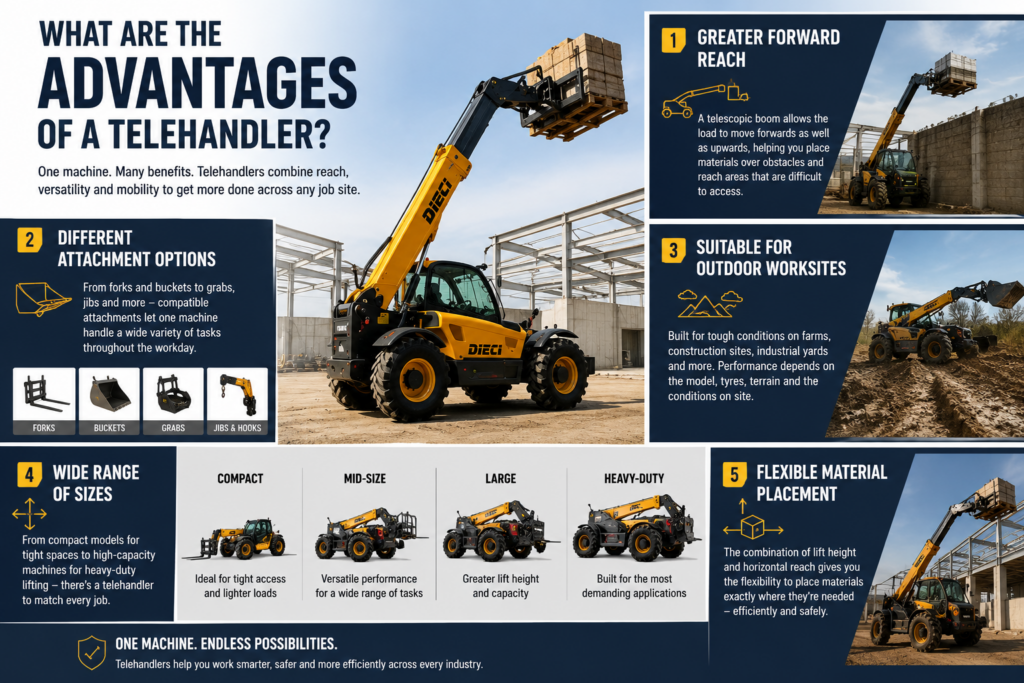
The main advantage of a telehandler is not any one specification. It is the combination of several useful capabilities in one machine.
Greater Forward Reach
A telescopic boom allows the load to move forwards as well as upwards.
This can make it possible to position materials over obstacles or reach placement points that cannot be approached directly.
Different Attachment Options
Compatible attachments can allow one telehandler to perform several types of material-handling work.
Instead of selecting a machine solely because it can carry forks, businesses can consider what attachments will be required throughout the machine’s normal working cycle.
Suitable for Outdoor Worksites
Many telehandlers are designed around the conditions encountered on farms, construction sites, industrial yards and other outdoor operations.
The exact suitability still depends on the model, tyres, terrain, gradients and operating environment.
Wide Range of Sizes
Telehandlers are available from compact machines for tighter work areas through to larger machines capable of substantial lift heights and capacities.
This allows buyers to select equipment more closely matched to the job rather than simply choosing the largest machine available.
Flexible Material Placement
Perhaps the biggest practical benefit is the combination of lifting height and horizontal reach.
If materials repeatedly need to be placed somewhere that cannot be approached vertically from directly underneath, this flexibility can become extremely valuable.
Are There Any Limitations to Telehandlers?
Telehandlers are versatile, but they are not the right solution for every lifting task.
Their lifting capacity changes according to boom position, so operators must understand the machine’s load chart.
Large machines may also require significant space for manoeuvring and setup. Rotating telehandlers can reduce some repositioning requirements, but stabilisers and the rotating working envelope may introduce their own space requirements.
Ground conditions also matter.
A telehandler capable of a particular lift on suitable level ground should not automatically be assumed to have the same operating capability under different site conditions.
Transport dimensions, machine weight, storage, servicing, attachment availability and operator requirements should therefore all form part of the purchasing decision.
How Do You Choose the Right Telehandler?
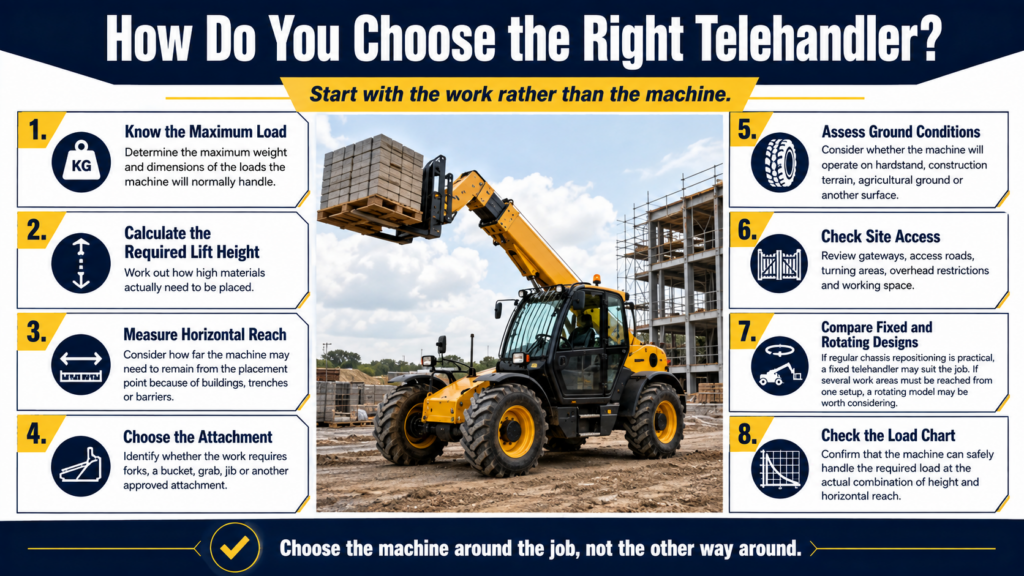
Start with the work rather than the machine.
1. Know the Maximum Load
Determine the maximum weight and dimensions of the loads the machine will normally handle.
Do not consider only the single heaviest object. Understanding common everyday loads can also help identify the most practical machine.
2. Calculate the Required Lift Height
Determine how high materials actually need to be placed.
A machine offering significantly more height than the job requires may not automatically be the best option.
3. Measure Horizontal Reach
This is one of the most important telehandler specifications.
Consider how far the machine may need to remain from the placement point because of buildings, trenches, barriers or other obstacles.
4. Choose the Attachment
Identify whether the work requires forks, a bucket, grab, jib or another approved attachment.
Attachment selection should happen while choosing the machine rather than after the purchase.
5. Assess Ground Conditions
Consider whether the machine will operate on prepared hardstand, construction terrain, agricultural ground or another surface.
Ground conditions can affect machine operation and setup.
6. Check Site Access
Look at gateways, access roads, building entrances, turning areas, overhead restrictions and working space.
A machine can have excellent lifting specifications but still be impractical if it cannot efficiently move around the site.
7. Compare Fixed and Rotating Designs
Think about how often the telehandler will need to work in different directions.
If regular chassis repositioning is practical, a fixed telehandler may suit the application.
If several work areas need to be served from one suitable setup location, a rotating machine may be worth considering.
8. Check the Load Chart
Finally, confirm that the machine can safely handle the required load at the actual combination of height and horizontal reach.
This is far more useful than comparing maximum lifting capacity alone.
Telehandler Safety and Operator Requirements
A telehandler is powerful lifting equipment, which means safe operation depends on much more than knowing how to move the boom.
Operators need to understand the manufacturer’s operating instructions and the load chart for the particular machine and attachment configuration.
The work area should also be assessed before operation.
Ground conditions, gradients, overhead hazards, nearby workers, other machinery and the space required to manoeuvre or stabilise the machine can all affect the job.
Particular attention is needed when the boom is extended because machine capacity and stability can change as the load moves farther away from the chassis.
Operator training and licensing requirements may also vary depending on the machine’s configuration, attachments and the work being performed. Businesses should confirm the requirements that apply to their specific operation rather than assuming that operating one type of lifting equipment automatically qualifies someone to operate every telehandler configuration.
Telehandler Selection Checklist
Before buying or specifying a telehandler, ask:
- What is the maximum load weight?
- What are the load dimensions?
- How high must the load be lifted?
- How much forward reach is required?
- What attachment will be used?
- What does the load chart allow at the required boom position?
- What are the ground conditions?
- How much turning and manoeuvring space is available?
- Are there overhead or access restrictions?
- Will stabilisers need additional setup space?
- How often will the machine need to be repositioned?
- Does the site suit a fixed or rotating telehandler?
- How will the machine be transported?
- What servicing and parts support will be required?
- What operator or site requirements apply?
Answering these questions before comparing individual models can make telehandler selection much easier.
Is a Telehandler Right for Your Worksite?
A telehandler can be a practical choice when a job requires more than simply lifting something vertically.
If materials need to travel across outdoor work areas, be placed at height, reach beyond an obstacle or be handled using different approved attachments, a telescopic handler may provide a useful combination of mobility, lifting capability and forward reach.
The decision should still begin with the application.
Know your load. Measure the required height and horizontal reach. Understand the ground and access conditions. Identify the required attachment. Then compare those requirements with the specifications and load charts of suitable machines.
Wing Gear supplies fixed and rotating telehandlers for applications across agriculture, construction, mining and industrial material handling.
Explore the complete Wing Gear telehandler range or contact Wing Gear with your load, required lift height, horizontal reach, attachment and site conditions to discuss suitable options.
Frequently Asked Questions About Telehandlers
What is another name for a telehandler?
A telehandler is short for telescopic handler. The term telescopic forklift is also sometimes used informally, although a telehandler differs structurally from a conventional forklift because it uses a telescopic boom rather than a standard vertical mast.
Is a telehandler the same as a forklift?
No. Although both machines can lift materials and may use fork tines, their lifting systems are different.
A conventional forklift generally uses a vertical mast, while a telehandler uses a telescopic boom that provides both vertical lift and horizontal reach.
What are telehandlers mainly used for?
Telehandlers are used for lifting, moving and positioning materials across construction, agriculture, mining, industrial and infrastructure environments.
The exact application depends on the machine, attachment and working conditions.
Can a telehandler use different attachments?
Yes. Depending on the machine, compatible attachments may include pallet forks, buckets, grabs, lifting jibs, hooks and other specialised attachments.
The attachment must be suitable for the particular telehandler, and its effect on lifting capacity needs to be considered.
What is the difference between a fixed and rotating telehandler?
A fixed telehandler normally requires the chassis to be repositioned when working in substantially different directions.
A rotating telehandler has an upper structure capable of rotating relative to the chassis, which can allow different work areas to be reached from one appropriately prepared setup position.
How high can a telehandler lift?
Lift height varies considerably between telehandler models.
Rather than selecting a machine according to maximum height alone, businesses should consider the load that needs to be handled at the required height and horizontal reach.
How do I know which telehandler I need?
Start with five essential details:
Load weight, lift height, horizontal reach, required attachment and site conditions.
Once those are known, you can compare machine specifications and load charts to identify suitable options.